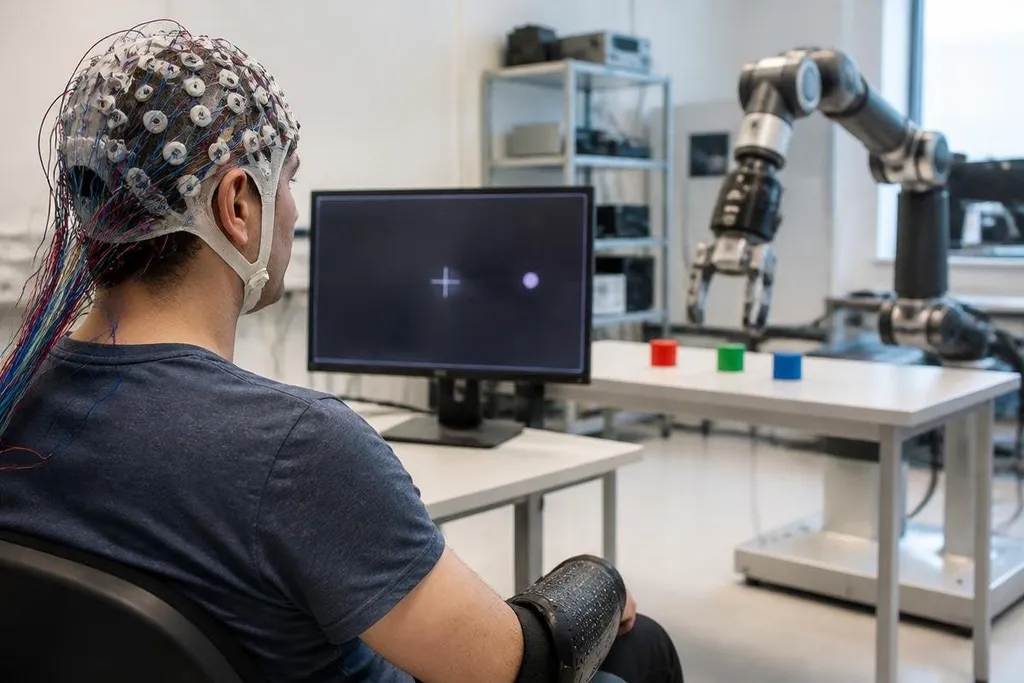
A brain signal can move a cursor in a lab. Turning that signal into safe, useful robot motion is a harder job. Neuro-robotics sits at that gap, linking neural activity with prostheses, exoskeletons, robotic arms, and rehabilitation systems.
Quick read
- Brain-computer interfaces read patterns linked to intended movement
- Feedback helps a person adjust control instead of sending one-way commands
- Daily use depends on signal quality, setup time, safety, and cost
What neuro-robotics actually does
Neuro-robotics combines robotics with systems that measure activity from the nervous system. A brain-computer interface, or BCI, turns recorded neural signals into commands for software or a robot. Those commands might select a direction, open a robotic hand, or change the speed of a motor.
The signal can come from sensors placed on the scalp, attached to the body, or implanted near neural tissue. Each method brings a different trade-off. External sensors avoid surgery, while implanted systems can record signals closer to their source, where the data may be easier to separate from muscle movement and electrical noise.
The robot still needs its own sensors. Position sensors track joints, force sensors detect contact, and cameras or depth sensors help the system understand nearby objects. A control system combines those inputs with the neural command before it moves.
That shared control matters. A person may signal an intention to reach for a cup, while the robot handles joint motion, speed limits, and collision checks. The person sets the goal; the robot handles much of the movement.
Where the promise is strongest
Medical devices offer the clearest reason to build this technology. A robotic prosthesis could use signals linked to an intended hand movement, while sensors in the socket measure contact with an object. The person gets a control method, and the device gets information about the body and the object it touches.
Rehabilitation is another practical use. A robotic exoskeleton can support a leg during repeated steps while sensors record movement and effort. Therapists may use that information to adjust assistance during a session, though the useful result depends on the patient, the device, and the treatment plan.
Research tools are another use for neuro-robotics. A robotic arm can give a person with limited movement a way to interact with objects, while the system records the timing between intention, command, and action.
Shared control makes a neural decoder’s speed only part of the test. Neuro-robotics reports from Robot24.com can show the decoder’s signal rate and the arm’s response time. That record leads to the next test: how much routine movement the robot handles without a new command.
The strongest systems will probably share control rather than ask a person to command every joint. That reduces the number of signals the user must produce and leaves the robot to handle routine movement.
The hard limits
Neural signals change with fatigue, attention, electrode placement, and movement. A system trained during one session may need new calibration later. For a person using a prosthesis or exoskeleton, that setup burden can decide if the device leaves the lab.
Speed is another limit. A robot may respond quickly once it has a clean command, but the person may need time to produce that command and correct an error. A slow control loop can make a simple task feel tiring.
Feedback remains difficult too. Sight can show where a robotic hand is, but it doesn't fully replace touch. Force feedback, vibration, sound, and pressure sensors can give more information, yet each signal adds another thing for the user to learn.
Safety comes before a faster response. The robot must stop when its sensors disagree, the signal becomes unclear, or a person moves into its path. That means the system needs a safe state that works even when the neural input fails.
I’d wait for long daily-use results before treating a brain-controlled robot as ready for routine care or work.
A practical check before adoption
A hospital, lab, or device team can ask:
- Define the task: specify the movement the system must support and the time it may take.
- Check the signal: measure how often the device loses a command during normal use.
- Test setup: record calibration time, sensor placement, cleaning, and staff training.
- Keep a manual control: give the person another safe way to stop or guide the robot.
- Track the user: record fatigue, errors, comfort, and task completion across repeated sessions.
- Name the open issue: state what the system has not shown outside its test setting.
These checks move the discussion away from a clean demonstration and toward a device that someone can use each week. The useful measure is not how quickly a signal reaches a robot. It is how reliably that connection helps a person complete a real task.
The next proof point for neuro-robotics is sustained use: a person controlling the same device across ordinary sessions, with fewer resets and clear safety records.